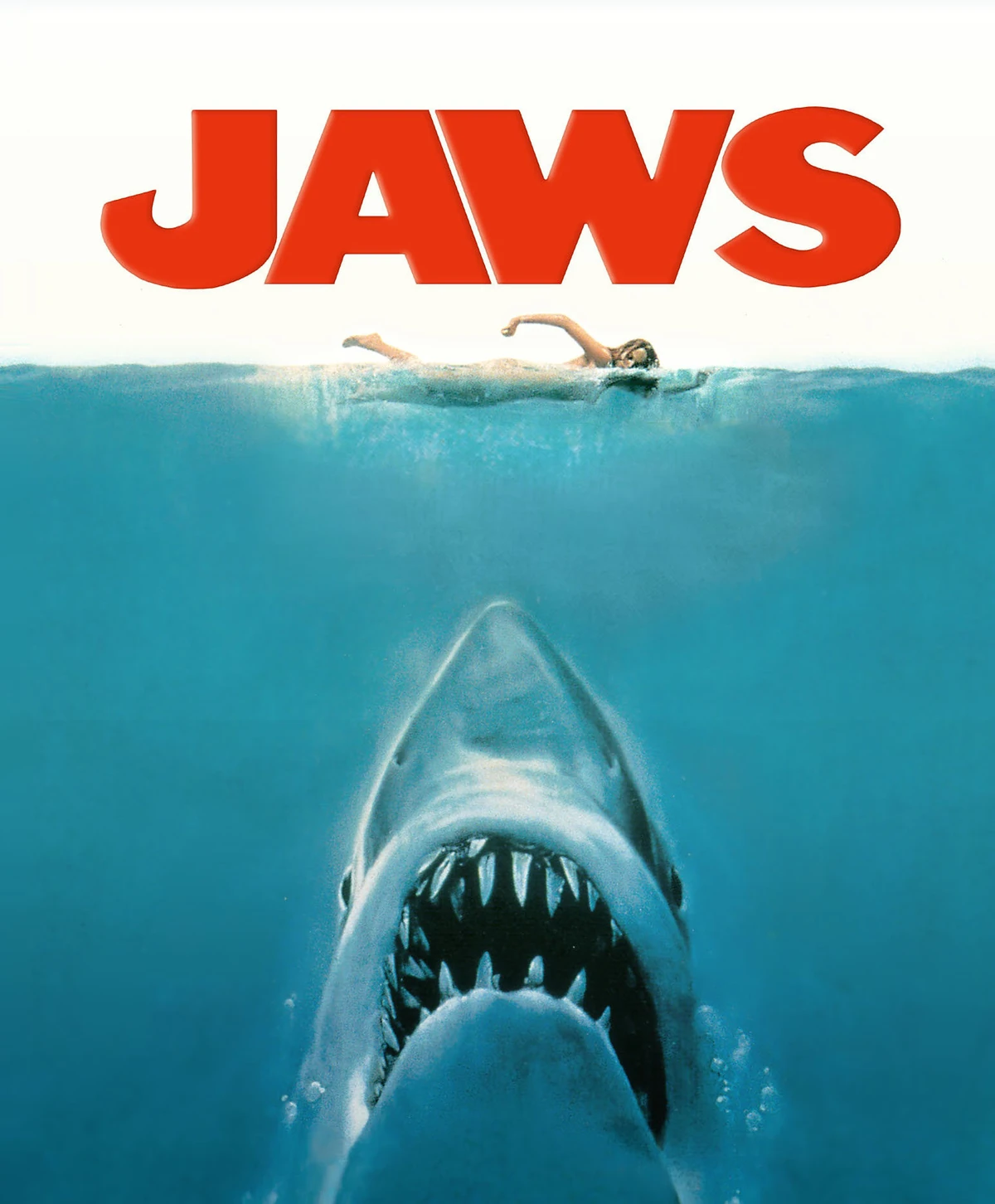
Jaws
The film, its legacy and the people behind it.
The Legacy of Jaws: Practical Terror vs. Modern CGI
When Steven Spielberg released Jaws in 1975, he didn't just direct a movie—he invented the summer blockbuster and changed cinema forever. Unlike today's CGI-heavy films with hyper-intelligent monsters, Jaws was terrifying because it felt real. The antagonist wasn't evil; it was simply an apex predator following its instincts, leaving beachgoers in the wrong place at the wrong time.
This grounded, suspenseful story struck a chord globally. Jaws earned an extraordinary $470 million at the worldwide box office—equivalent to over $2 billion today—and kept an entire generation out of the ocean.
Its colossal success launched a decade of anticipation for sequels:
Jaws 2 (1978): Successfully maintained the original suspense and strong lead performances.
Jaws 3-D (1983): Shifted to a marine park setup, leaning heavily into 3D gimmicks.
Jaws: The Revenge (1987): Unfavorably remembered for its absurd plot about a shark seeking personal vengeance.
While later sequels lost their edge, the 1975 original remains unmatched. Decades later, Jaws proves that masterclass pacing, practical effects, and iconic music will always trump cheap computer graphics.
In 1975, the movie Jaws came out in cinemas. It became a huge hit and changed movies forever.
Many modern shark movies use computer graphics (CGI) to show smart, evil monsters. But Jaws was different and much scarier. The shark was not evil. It was just a big fish looking for food, and the people were in the wrong place at the wrong time.
People loved the story. The movie made over $470 million around the world. Because of this success, many people were scared to go swimming in the ocean!
The big success led to three sequels:
Jaws 2 (1978): A good movie that was still scary like the first one.
Jaws 3-D (1983): Took place in a water park and used 3D effects.
Jaws: The Revenge (1987): A funny story about a shark trying to get revenge on a family.
Even with bad sequels, the original Jaws is still the best. It shows that good music and real suspense are better than modern computer effects.
An Interview with Roy Scheider
Introducing Roy Scheider: The Face of Jaws
Fresh off his Oscar-nominated role in The French Connection, actor Roy Scheider sat down for a televised interview on the eve of a cinematic revolution. With Jaws set to open in theaters the next day, Scheider shared behind-the-scenes stories about the film's production—from freezing weather on Martha's Vineyard to the nightmare of shooting on unpredictable open waters. In this interview, Scheider discusses the overwhelming reactions from early preview audiences, the mechanical shark as a ultimate antagonist, and why beaches might be a lot quieter this summer.
Secrets Behind the Movie Jaws
In 1975, Jaws changed Hollywood forever and became the first official summer blockbuster. But did you know the movie was almost a complete disaster? Filming on the open ocean was extremely difficult, and the mechanical shark broke down almost every day. Because of these technical problems, director Steven Spielberg had to hide the shark and use creative camera angles to build suspense. Watch this video to learn 20 amazing hidden details, improvised iconic lines, and secret facts about how Jaws was made!
Jaws changed how Hollywood saw the Summer
Before 1975, major film studios treated the summer season as a dumping ground for low-quality movies, operating on the belief that audiences preferred spending warm months outdoors rather than inside movie theaters. The release of Jaws permanently shattered this industry norm, creating the modern summer blockbuster and completely restructuring Hollywood's release calendar.
The transformation was driven by three revolutionary release strategies:
The Wide "Nationwide" Launch: Instead of the traditional slow rollout—where a film opened in a few major cities before expanding over several months—Universal Pictures released Jaws simultaneously in over 400 theaters nationwide on June 20, 1975.
Prime-Time Television Saturation: Universal invested roughly $2 million in heavily targeted prime-time television commercials during the week leading up to the release, generating instant, nationwide anticipation.
Synchronized Event Culture: By combining nationwide availability with heavy television advertising, audiences across the country experienced the film at the exact same time, driving massive word-of-mouth momentum and record-breaking line-ups.
Jaws went on to gross over $400 million globally, proving to studio executives that summer could be the most profitable window of the year. Ever since, Hollywood has reserved the May-to-August calendar for its biggest, highest-budget event movies.
Before 1975, movie studios thought people did not want to watch movies in the summer. They believed people preferred to stay outside in the warm weather. Because of this, studios only released bad or cheap movies during the summer months.
When Jaws came out in June 1975, everything changed. It became the first real "summer blockbuster" and proved that summer was a great time for movies.
The movie studio used three new ideas to make Jaws a success:
Big Opening Day: Usually, movies opened in just a few big cities first. But Jaws opened in over 400 theaters across the country on the exact same day.
TV Advertisements: The studio spent $2 million on TV ads during the week before the movie started. Millions of people saw the ads at home.
National Excitement: Because everyone could watch the movie at the same time, people everywhere talked about it. Long lines formed outside theaters all over the country.
Jaws made more than $400 million around the world. It showed Hollywood that summer is actually the best time to sell big movies. Today, studios still save their biggest, most expensive films for the summer season!
Jokes